
Aim and purpose of surgery:
What is surgery? why do we do it? Surgery is a medical specialty that uses various “operative techniques” to treat or resolve medical conditions. There are also different types of surgery that would be performed based on: urgency, targeted body part, nature of the procedure, invasiveness, and instruments needed.
A quick tip: These different categories are not relevant to us right now- but if you want to find out more about them later, you can visit the following link: https://www.docdoc.com/medical-information/procedures/surgery
You can find dozens of clinical definitions regarding the aim of surgery. But the overall aim of surgery is to ultimately help your patient’s physical and mental state by performing a procedure that relieves them of any pain or illness. Whether that’s plastic surgery where you help them achieve their dream appearance, or whether that is neurosurgery where you rid them of any tumors or physical disorders. Surgeries are all done with the same aim but vary in reason. For example, the purpose or reason for surgeries can be grouped as follows:
- Diagnosis: a surgical procedure can determine whether a patient has a certain disease, illness, or condition.
- Prevention: Preventative surgeries remove tissues or even organs that have the potential to become cancerous and it ensures the patient will not suffer from any condition, or illness, in the future.
- Ablation: This refers to the destruction of harmful tissues in the body.
- Reconstruction: Reconstructive surgery is done to either restore the use or function of a certain body part (such as a hip replacement) or to improve appearance (mastectomy).
- Transplantation: This is a medical procedure to replace a tissue or organ that no longer functions fully.
- Palliative care: This procedure, or treatment, is done with the aim of reducing pain or symptoms of illnesses that cannot be cured.
Fields of surgery:
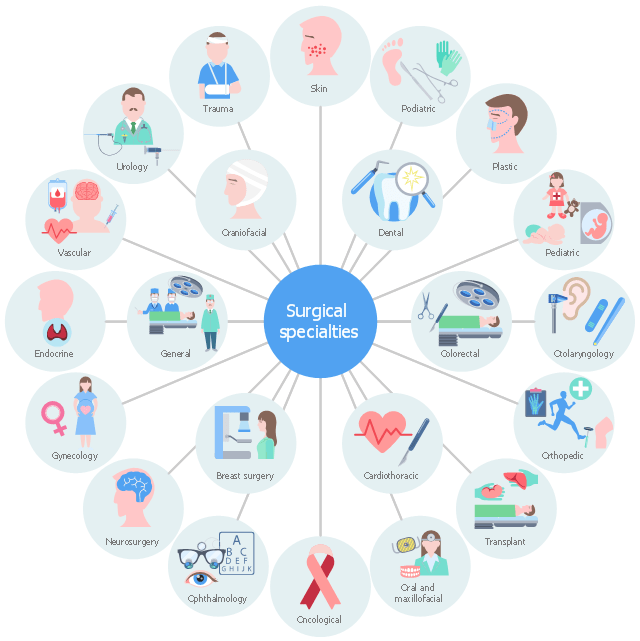
Within the specialty of surgery, there are many sub-specialties that treat different areas of the body, and even different types of patients. The fields of surgery (or sub-specialties) are wide and way too long to list all of them now, but the ones that are most commonly found in hospitals today are:
| Specialty | Description |
| General surgery | Rather than specializing in a small part of the body, a general surgeon possesses knowledge regarding the entire surgical process, from initial consultation to post-operative care. Most common surgeries that are carried out by general surgeons include appendicitis, hernias, stomach repair, gallbladder issues, and intestinal repairs. |
| Plastic surgery | Plastic surgery can either be reconstructive (repairing features after an accident such as burns) or purely aesthetic/cosmetic (liposuction or rhinoplasties).This field of surgery is usually focused on the skin (scars, burns, etc), maxillofacial (the facial skeleton), and congenital anomalies (cleft palate or deformed ears) |
| Neurosurgery | Neurosurgery is the medical specialty that concerns itself with disruptions to the spinal cord, disorders in the brain, and peripheral nerves all over the body. The role of a neurosurgeon is to assess, diagnose, and treat conditions that affect your body’s nervous system. A neurosurgeon is skilled in many forms of surgery, including open surgery, minimally invasive, endoscopic, microsurgery, radiosurgery, and chronic pain procedures. |
| Cardiothoracic surgery | This field of surgery focuses on the organs inside the thoracic cavity, especially the heart, lungs, and esophagus. Diseases that are treated by cardiothoracic surgeons include coronary artery disease, atrial fibrillation, heart and lung transplants, lung disease, and much more. |
| Orthopedics | Orthopedics is a medical specialty that concerns itself with the musculoskeletal system. This includes bones, joints, tendons, ligaments, and muscles. As the musculoskeletal system is wide and expansive, many orthopedic surgeons choose to specialize more closely in one area of this system, for instance, knee joints or bones in the hand. |
| Surgical oncology | This specialty focuses on removing cancerous tumors from nearby tissues. Surgical oncologists assess and treat cancer patients, and they work closely together with a primary care doctor to provide the best course of treatment. They conduct biopsies to diagnose cancer and see how severe it is. |
| Pediatric (general surgery, oncology, orthopedic) | Now lastly, pediatric surgery can vary from just general pediatric surgery to pediatric oncology and even pediatric orthopedics. Pediatric surgeons focus on operative care for children. A common misconception is that it is just general surgery in mini form, which is not true. It requires special skills and experience to operate on children. Pediatric oncologists treat children who have cancer. Much like regular oncology, they perform biopsies to find cancerous cells and then remove tumors and surrounding tissues. Pediatric orthopedic surgeons repair damages to bones or joints such as a fractured femur or patella dislocation. |
A quick tip: This was a lot of information all at once, and you don’t need to know all of this off-hand. For now, just remember that even if you decide you’re interested in surgery, there are still many fields you can choose from. And each of these sub-specialties will require a different set of skills…
Education process:
The education process for the surgeon starts off the same, just like any other medical professional. First, earn a high school diploma and get accepted into either pre-med or directly into medical school. This will depend on where you are doing your studies; the education system differs in every country. After finishing medical school, you will complete a surgical residency where you can experience all different fields of surgery, which will ultimately help your decision process as well. After residency is the time where you will need to make a choice and complete a fellowship for your chosen specialty. The duration of this will depend on what field you’re specializing in, however, after your fellowships, you will be required to achieve board certification which identifies you as a trained surgeon.
This is a very basic overview of the education process a surgeon goes through. However, not only will this take up to 7-10 years, but every country and every hospital has different requirements. So make sure you check up on exactly what is required of you in the country where you wish to study.
Benefits and disadvantages:
I’ve already mentioned the benefits and disadvantages of each sub-specialty; but how about surgery in general? Well, as I mentioned you don’t need to choose a field of surgery until after your medical school and 5-year residency, meaning you will have plenty of time for that. But to know if you even want to consider surgery as an option, you should know some benefits. Firstly, this is the most obvious and common reason so I won’t elaborate too much; you can help people who aren’t able to help themselves. But that applies to any field of medicine you choose, so let me be a bit more specific in regard to surgery. It is one of the most challenging fields you could specialize in; so if you like a challenge and using critical thinking skills, surgery is a great way to go. As a surgeon, you can learn everything there is to know about one specific body part; you will become an expert in it. This field of medicine is also one of the most rewarding specialties; you can use your knowledge and your skill to impact a person and heal them.
But I must tell you there are also several disadvantages to becoming a surgeon. There is basically no such thing as a work-life balance. Your entire life will be dedicated to your patients and your work. Especially with emergency surgeries- you might be on call at all hours of the day. There is also a great risk of burnout after a couple of years; the education path is tough for every medical profession, but surgeons will suffer greatly with long working hours and in the first couple of years, the pay will not be that great either. As a surgeon, there is a very real and likely possibility that you will lose a patient in surgery; sometimes there was nothing anyone could do, but that won’t stop you from feeling extremely guilty, especially the first couple of times.

Skills you should possess:
As mentioned above, different surgeons need different skills. Yet there are various soft skills and personality traits that make you an ideal candidate for becoming a surgeon. This includes:
- Adaptation and critical thinking: As a surgeon, there will be a series of events, both in the operating theatre and outside, where situations will escalate. You often won’t know what to do as everything will change from one second to the next when you least expect it. Therefore, critical thinking is a necessity, and the ability to adapt your course of treatment might very well be the difference between life and death. Critical thinking is an essential skill for a surgeon as some diagnoses might be wrong and another one has to be drawn, in the heat of the moment.
- Leadership and teamwork: Any specialty in medicine needs a multidisciplinary team to function- but surgery is unable to function without a team of physicians and nurses. For instance, in the operating theatre, there will always be a team of healthcare professionals who might seem like a crowd at times but is absolutely essential for the patient’s survival and comfort. For instance, the anaesthesiologist ensures the patient is under medication for the entire procedure and does not feel any pain. Different nurses will also be present; to hand you equipment, or sanitize everything. So as the head physician in the OR, you will need to cope with many people surrounding you and you will have to display leadership skills. Sometimes it is required for you to tell people what you need them to do, especially in stressful situations.
- Observation skills: To draw diagnoses or determine what has gone wrong in certain situations, a surgeon requires good observational skills. An expert surgeon in an OR requires the ability to assess situations and act accordingly, which requires a fair amount of detail-oriented perspective and observation. Especially for plastic surgeons, it’s also a technical skill needed, to ensure that the wound of a patient is barely visible and that the patient is not reminded of the incident every time they look at their arm, stomach, or other body parts.
- Stamina: Being a surgeon is a very tiring job, with long hours and hard work. To decrease the risk of burnout after a few years of working, or even in university, you will need to have good stamina and the ability to overcome boring days and events. You will want to quit and give up several times in your career- every surgeon does. This is nothing to be ashamed of but if you don’t possess stamina or grit, there will be a bigger chance of you giving up. On a more short-term basis, a surgeon needs to be able to stand for a long time in the OR, using their hands and thinking critically. Therefore, it is essential that the surgeon has stamina and good health as well.
Summary
To summarise, the only thing you really need to know, at least for now is what surgery is and if you should consider it as an option in your decision. Surgery is one of the most interesting fields of medicine you could specialize in – there is almost never a boring day. High-stakes situations can be stressful, yes, but surgery is an extremely rewarding profession. You can use your knowledge to help and change the lives of countless people which is incredibly fascinating, in my opinion.
 Medical Specialties